Glyphosate is one of the most widely used herbicides in the world and the primary active ingredient in many weed-control products. Because of its widespread agricultural use, low-level exposure may occur through food, water, and the environment.
Researchers continue to investigate how ongoing glyphosate exposure may affect human health, including its potential relationship with oxidative stress, the gut microbiome, mitochondrial function, and cellular detoxification pathways.
This growing concern has also raised an important question: Could EBO2 help the body process and eliminate compounds such as glyphosate?
Although more clinical research is needed, the oxidative chemistry involved in EBO2 provides a compelling reason to continue studying its potential role.
Understanding Glyphosate
Glyphosate works by inhibiting an enzyme in the shikimate pathway, a biochemical process plants use to produce certain essential amino acids. Human cells do not have this pathway, but many microorganisms do, including some bacteria found within the gut.
Laboratory and animal research has explored whether glyphosate exposure may influence:
- The composition of the gut microbiome
- Oxidative stress
- Mitochondrial function
- Mineral availability
- Cellular antioxidant activity
- Inflammatory signaling
The significance of these effects in humans, particularly at typical environmental exposure levels, is still being evaluated. However, the research provides a strong reason to study therapies that may support antioxidant defenses and the body’s natural detoxification systems.
Ozone Can Degrade Glyphosate
One of the most interesting areas of research involves the interaction between ozone and glyphosate.
Under controlled laboratory and water-treatment conditions, ozone has been shown to react with glyphosate and break down its chemical structure. This process, known as ozonation, is already studied and used in environmental applications to help degrade pesticides and other organic contaminants.
Ozone may act through direct oxidation and through the formation of additional reactive species that contribute to the degradation process. Researchers have demonstrated that this reaction can transform glyphosate into smaller compounds that may undergo further breakdown.
This does not yet prove that EBO2 directly eliminates glyphosate from a patient’s body. Blood is much more biologically complex than water, and direct human studies are needed. Still, the established interaction between ozone and glyphosate offers a promising scientific rationale for further investigation.
How EBO2 May Support the Body’s Response
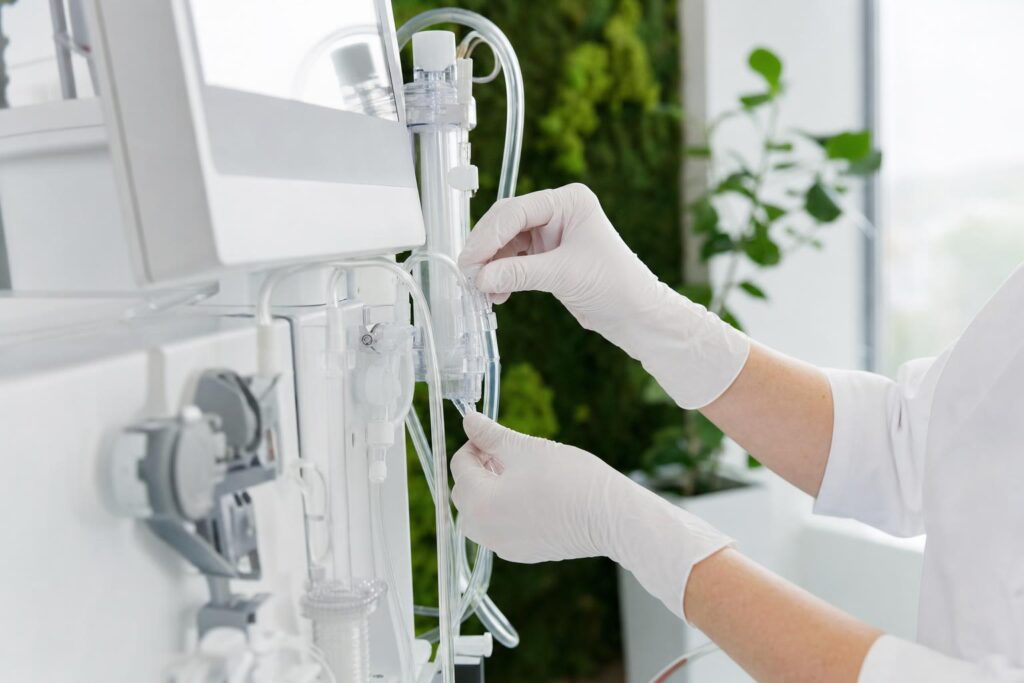
During EBO2, blood circulates through a specialized extracorporeal system, where it is exposed to a precisely controlled oxygen-ozone mixture before being returned to the patient.
Ozone reacts rapidly with components in the blood and generates secondary signaling molecules. These reactions may activate adaptive biological responses related to antioxidant protection, oxidative balance, and cellular signaling.
Rather than thinking of EBO2 as simply “washing” a chemical out of the blood, its potential value may involve several complementary mechanisms.
Supporting antioxidant defenses
Controlled oxidative exposure may stimulate the body’s own antioxidant systems. Glutathione is one of the body’s most important antioxidants and plays a central role in protecting cells and supporting the processing of certain environmental compounds.
Research into medical ozone suggests that carefully controlled oxidative signaling may influence antioxidant pathways. This could be relevant when studying environmental exposures associated with oxidative stress.
Supporting mitochondrial function
Mitochondria produce the energy cells need to function. Environmental stressors are being studied for their potential effects on mitochondrial activity and oxidative balance.
EBO2 is being investigated for its ability to influence oxygen utilization, redox signaling, and cellular resilience. These effects may help support the body’s response to oxidative challenges, although research specific to glyphosate exposure is still needed.
Supporting the body’s natural elimination pathways
The liver, kidneys, gastrointestinal tract, and antioxidant systems work together to process and eliminate unwanted compounds.
EBO2 may support the biological environment in which these systems operate by influencing oxidative signaling and antioxidant activity. Whether this results in greater glyphosate elimination has not yet been established, but it represents an important area for future research.
Potential direct chemical interaction
Because ozone can degrade glyphosate under controlled laboratory conditions, researchers may also explore whether meaningful interaction can occur during extracorporeal blood processing.
This remains a scientific hypothesis. Future studies would need to measure glyphosate and its metabolites before and after treatment to determine whether EBO2 produces a direct and measurable effect.
An Emerging Area of Study
The potential relationship between EBO2 and glyphosate should be viewed as an emerging area of research rather than a settled clinical application.
Current evidence provides several reasons for continued investigation:
- Ozone can degrade glyphosate in controlled nonclinical settings.
- Glyphosate exposure is being studied in connection with oxidative stress and mitochondrial effects.
- Controlled ozone exposure may influence antioxidant and redox-signaling pathways.
- EBO2 processes a substantial volume of blood through a controlled extracorporeal circuit.
- Changes in glyphosate levels could be objectively evaluated through future clinical studies.
Together, these factors create a plausible foundation for studying whether EBO2 can help the body process or eliminate glyphosate.
A Responsible Approach for Providers
Providers should avoid guaranteeing that EBO2 removes glyphosate or describing it as a proven treatment for pesticide exposure. Instead, it may be discussed as an advanced oxidative therapy with mechanisms that are relevant to antioxidant defense, cellular signaling, and environmental health research.
Patients concerned about glyphosate should receive an individualized evaluation that considers their symptoms, occupational exposure, diet, medical history, and overall health. Reducing continued exposure should also remain a central part of any environmental-health strategy.
Advancing EBO2 Through Better Research
At PURXCELL, we believe EBO2 has significant potential, including applications that have not yet been fully explored. Understanding how extracorporeal oxygen-ozone therapy may influence environmental compounds is one of several exciting areas for future investigation.
The ability of ozone to degrade glyphosate outside the body does not automatically prove the same result during EBO2. However, it provides a meaningful scientific starting point.
As research advances, carefully designed studies may help determine whether EBO2 can directly reduce glyphosate levels, support the body’s elimination pathways, or help address some of the oxidative effects associated with environmental exposure.
The science is still developing, but the potential deserves thoughtful exploration.
This article is intended for professional education and discussion. Research has not yet established EBO2 as a treatment for glyphosate exposure or demonstrated that it removes glyphosate from the human body.